Knowing first aid and CPR is essential for saving lives during emergencies. However, many people find themselves unsure when faced with real situations. This article provides expert-level first aid and CPR questions and answers to build your confidence and readiness. We will cover important basics, common concerns, and practical steps you can take immediately.
# Understanding the Core Concepts of First Aid and CPR
**Q: WHAT IS THE DIFFERENCE BETWEEN FIRST AID AND CPR?**
First aid refers to the immediate assistance given to any injured or ill person before professional help arrives. It covers a broad range of situations such as cuts, burns, choking, and fractures. CPR, or Cardiopulmonary Resuscitation, is a specialized emergency procedure focused on restoring breathing and circulation in someone who has stopped breathing or whose heart has stopped beating.
**Answer:** First aid is the overall care provided right after an injury or sudden illness. CPR is a lifesaving technique used within that care, specifically for cardiac arrest and breathing failure.
# When and How to Perform CPR: Key Guidelines
**Q: WHEN SHOULD CPR BE PERFORMED?**
CPR is necessary when a person is unresponsive, not breathing, or only gasping irregularly. These signs indicate cardiac arrest, which requires immediate CPR to maintain blood flow to vital organs until emergency services arrive.
**Answer:** Start CPR immediately if the person is unconscious and not breathing normally. Chest compressions combined with rescue breaths increase survival chances.
# What Are the Steps to Administer Effective CPR?
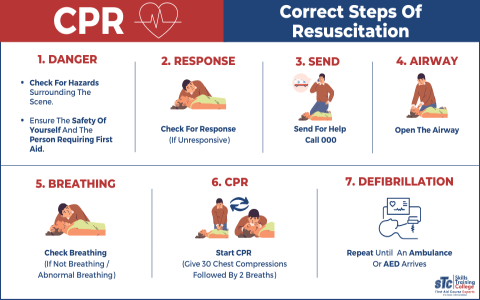
Here is a simple step-by-step guide:
1. Check the scene and the person for safety and responsiveness.
2. Call emergency services or ask a bystander to call.
3. Open the airway using the head-tilt chin-lift method.
4. Check if the person is breathing normally for no more than 10 seconds.
5. If no normal breathing, begin CPR: 30 chest compressions followed by 2 rescue breaths.
6. Continue until help takes over or the person starts breathing normally.
# Common First Aid Questions and Their Answers
**Q: HOW DO I TREAT A BLEEDING WOUND?**
Apply firm pressure to the wound using a clean cloth or bandage. Elevate the injury above heart level if possible. Avoid removing embedded objects to reduce further damage. Seek medical help if bleeding is heavy and won’t stop.
**Q: WHAT SHOULD I DO IF SOMEONE IS CHOKING?**
If the person cannot cough, speak, or breathe, give abdominal thrusts (Heimlich maneuver). Stand behind the person, make a fist above the navel, and give quick upward thrusts until the object is expelled or they become unconscious.
# Important First Aid and CPR Myths Debunked (WARNING)
**WARNING: NEVER perform CPR without checking responsiveness and breathing first.** Starting CPR on someone who is breathing can cause harm. Also, recent American Heart Association guidelines note that hands-only CPR (compressions only) is recommended if rescuers are untrained or unable to perform rescue breaths. This is a significant update from previous teachings.
# The Role of Automated External Defibrillators (AED) in CPR
**Q: WHAT IS AN AED AND WHEN SHOULD IT BE USED?**
An Automated External Defibrillator is a portable device that analyzes heart rhythms and delivers an electric shock to restore normal rhythm in cardiac arrest victims. Using an AED with CPR dramatically increases survival rates. Turn on the AED and follow its voice prompts immediately after starting CPR.
# First Aid and CPR: Comparing Traditional vs. Hands-Only CPR Methods
| Aspect | Traditional CPR | Hands-Only CPR |
|---|---|---|
| Chest Compressions | 30 compressions | 30 compressions |
| Rescue Breaths | 2 breaths after compressions | No breaths given |
| When Recommended | Trained rescuers, children, drowning victims | Untrained or unwilling to provide breaths |
| Survival Effectiveness | Higher with breaths in certain cases | Still highly effective for adult sudden cardiac arrest |
| Ease of Learning | More complex | Simpler to learn and perform |
# Real-World Insights
According to the American Heart Association, immediate CPR can double or triple a victim’s chance of survival during cardiac arrest (source: heart.org). We know from experience in training sessions that even brief education on these questions and answers radically improves the willingness and ability of laypersons to act swiftly.
# First Aid and CPR: A Quick Checklist for Emergency Readiness
– Assess the scene for safety before helping
– Check victim responsiveness and breathing
– Call emergency services immediately
– Perform CPR when indicated: 30 compressions + 2 breaths or hands-only
– Use an AED as soon as it becomes available
– Control bleeding with firm pressure and elevation
– Perform choking relief if airway obstruction is suspected
– Avoid moving seriously injured persons unless necessary
– Keep the person warm and monitor until help arrives
Mastering first aid and CPR questions and answers makes you a crucial link in life-saving chains. Preparation is key because emergencies rarely announce themselves. With knowledge and confidence, you will be ready to respond effectively and make a real difference.