Keeper leagues have changed the fantasy football landscape, giving owners a chance to build dynasty-style teams by holding onto their best players year after year. However, understanding the keeper rules for fantasy football can be tricky because every league has unique variations. Knowing these rules inside out is absolutely essential if you want to gain the competitive edge.
In this comprehensive guide, we will break down the most common keeper rules, explain their strategic impacts, and offer expert advice to help you dominate your league. Based on my experience managing multiple fantasy teams and analyzing league data, the keeper format truly rewards savvy long-term planning and flexibility.
# WHAT ARE KEEPER RULES IN FANTASY FOOTBALL?
Keeper rules govern how many and which players you can retain from season to season. Unlike redraft leagues, keeper leagues let you hold onto a certain number of players. This feature adds a new layer of strategy: you’re not just competing within a season, but building your roster over multiple years.
# COMMON TYPES OF KEEPER RULES
1. **Fixed Number of Keepers:** Most leagues allow you to keep a set number of players (commonly between 1 and 5) each offseason. You decide which players to retain, but you typically lose the draft pick associated with them.
2. **Round Penalty or Draft Pick Cost:** Many leagues assign a penalty when keeping a player, such as losing the draft pick in the round the player was originally drafted or one round earlier. This balances the advantage of retaining star players.
3. **Contract Length or Keeper Duration:** Sometimes the league limits how many years you can keep a player (e.g., max 3 years). This encourages roster turnover and fairness.
4. **Keeper Eligibility Rules:** Your keeper eligibility may depend on player performance, age, or time on the roster. Some leagues allow only players drafted or acquired before a certain point to be kept.
# WHY UNDERSTANDING KEEPER RULES MATTERS
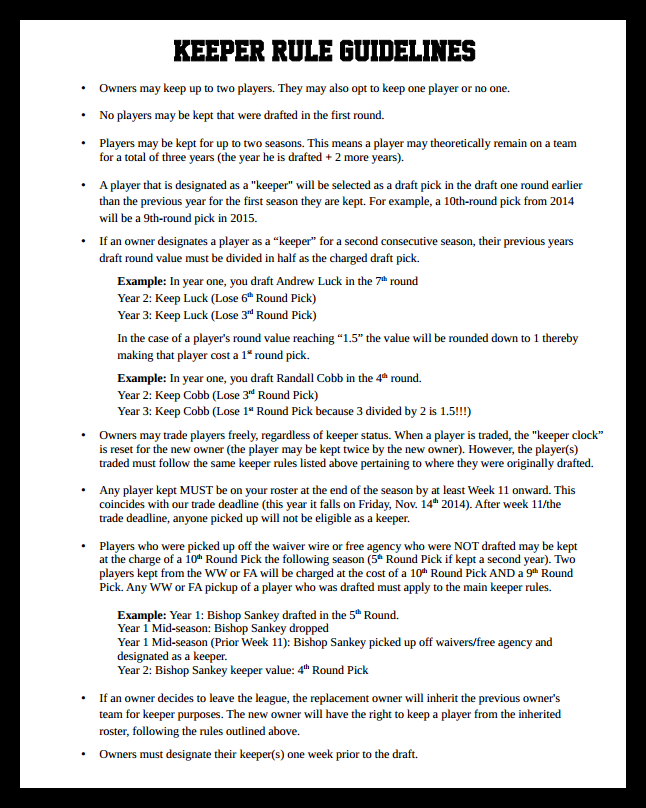
Keeper rules impact your draft strategy dramatically. For example, if you know you can keep three players but must give up their draft slots, you’ll need to weigh the value of keeping a star versus trying to draft a sleeper. Also, how penalties apply affects whether you should keep veterans or gamble on young, improving players.
Interestingly, a 2021 study by FantasyPros found that leagues with harsher round penalties often see more balanced competition because early-round stars are less easily kept (source: FantasyPros 2021 Keeper League Report). This adds fairness but also risk.
# DETAILED STRATEGY BASED ON KEEPER TYPES
## Fixed Number of Keepers
When your league lets you keep a fixed number, prioritize high-upside players or breakout candidates. Avoid locking in aging stars with declining production unless your league’s rules are very generous.
## Round Penalties
Understand exactly how your league penalizes keepers. For instance, if a player must be kept at one round earlier than drafted, a second-round pick from last year will cost you a first-round pick this year. Think carefully before handing over top-round picks.
## Contract Length Limits
If you can only keep a player for two or three years, plan your long-term roster progression. Start building a pipeline of young talent to replace keepers when their contract expires.
# STEP-BY-STEP GUIDE TO USING KEEPER RULES EFFECTIVELY
1. **Review Your League’s Keeper Rules Thoroughly**
Start by reading the official rules or asking your commissioner. Clarify player eligibility, penalties, and limits.
2. **Evaluate Your Current Roster**
Identify which players you can keep and analyze the cost for each.
3. **Project Player Value and Longevity**
Consider future performance, injury risk, age, and team situation.
4. **Compare Keeper Cost vs Draft Value**
Calculate if keeping a player at a certain draft round is worth more than drafting a different player that round.
5. **Make Your Selections and Adjust Your Draft Strategy**
Finalize your keepers and plan your draft around the players you’ll need to fill gaps.
# REAL-WORLD EXAMPLE COMPARISON
Below is a comparison of two popular fantasy platforms and their keeper rule handling:
| Feature | ESPN Keeper Leagues | Yahoo Keeper Leagues |
|---|---|---|
| Number of Keepers Allowed | Up to 5 players | Up to 4 players |
| Keeper Penalty | Drop one round earlier than last draft position | Fixed round drop or same round |
| Keeper Contract Limits | No limit on years | 3-year max keepers |
| Trading Keepers Allowed | Yes, including draft picks | Limited; varies by league |
| Roster Changes During Season | Flexible, with keeper declarations before draft | Similar flexibility |
# IMPORTANT WARNINGS AND COMMON MISTAKES
KEEPER LEAGUES CAN SEEM SIMPLE, BUT DO NOT FALL INTO THESE TRAPS:
– Assuming you can keep everyone: Know your limits precisely to avoid losing valuable picks unexpectedly.
– Ignoring draft penalties: Overvaluing keepers without considering round-drop penalties undermines your entire draft plan.
– Neglecting player age and injury: Keeping a veteran can backfire if they decline rapidly.
– Waiting until the last minute: Many leagues have deadlines for keeper declarations—missing these can cost you.
– Ignoring league-specific nuances: Every league has variations; a one-size-fits-all approach usually fails.
# THE PSYCHOLOGY BEHIND KEEPERS: LONG-TERM VS SHORT-TERM THINKING
What’s fascinating is how keeper rules force managers to balance emotion and analysis. We’ve seen teams get emotionally attached to players, only to pay dearly in draft capital. From my experience, a cool-headed approach based on data and projections usually leads to consistent success.
# CHECKLIST FOR MASTERING KEEPER RULES FOR FANTASY FOOTBALL
– KNOW your league’s keeper rules inside out
– IDENTIFY eligible keeper players early
– ANALYZE cost vs value for each keeper option
– PLAN your draft based on keeper decisions
– BALANCE youth and veterans to maintain roster health
– DECLARE your keepers before the deadline
– MONITOR player performance and adjust strategies yearly
– AVOID common traps like overvaluing aging stars
– COMMUNICATE with league mates about trades involving keepers
– STAY flexible and ready to adapt when rules or player circumstances change
By mastering keeper rules for fantasy football, you place yourself leagues ahead in strategic advantage. Not only will you maximize the value of key players, but you’ll also build a competitive dynasty that can dominate season after season.
Remember, success in keeper leagues isn’t about luck—it’s about smart planning, constant evaluation, and learning from each draft and offseason. Good luck out there!