# Introduction: Why Understanding Football Offense and Defense Positions Matters
Have you ever watched a football game and wondered why some players seem to always have the ball, while others are doing the heavy lifting on defense? Football offense and defense positions aren’t just labels—they are the blueprint that shapes every successful team and play on the field. Mastering these roles isn’t only for coaches and athletes. Fans, aspiring players, and even fantasy league participants can all benefit from understanding football offense and defense positions deeply.
In this guide, I’ll break down what each role does, clarify common confusions, and show you real-world strategies used by champions. Plus, you’ll get a step-by-step guide to identifying these roles, a comparison table, and practical tips to avoid common pitfalls. By the end, you’ll decode the secret language of football positions—let’s kick off!
# What Are Football Offense and Defense Positions?
To start, football offense and defense positions refer to the roles players take on either the attacking side (offense) or the defending side (defense) during a game. Each position has a primary responsibility. Offense tries to move the ball and score points, while defense aims to stop them.
## Key Offensive Positions
OFFENSIVE POSITIONS:
– Quarterback (QB): The leader, who throws or hands off the ball.
– Running Back (RB): Runs with the ball.
– Wide Receiver (WR): Catches passes.
– Tight End (TE): Blocks and receives.
– Offensive Lineman (OL): Protects the QB, opens running lanes.
## Key Defensive Positions
DEFENSIVE POSITIONS:
– Defensive Lineman (DL): Attacks the offensive line.
– Linebacker (LB): Versatile; tackles runners, covers receivers.
– Cornerback (CB): Covers wide receivers.
– Safety (S): Supports corners, guards against deep throws.
Let’s go deeper by examining how these roles interact on the field.
# Offense vs. Defense: Comparative Overview
To help you see the differences between offense and defense roles at a glance, here’s a quick comparison of their core duties and typical athletes.
| Position Type | Main Role | Typical Skills |
|---|---|---|
| Quarterback (Offense) | Leads, passes, reads defense | Vision, accuracy, leadership |
| Linebacker (Defense) | Tackles, covers, blitzes | Agility, tackling, awareness |
| Wide Receiver (Offense) | Catches passes, gains yards | Speed, hands, route-running |
| Cornerback (Defense) | Shuts down receivers | Speed, anticipation, coverage |
This table makes it obvious: Each position supports the team’s overall goals—in uniquely demanding ways.
# Common Football Offense and Defense Formations Explained
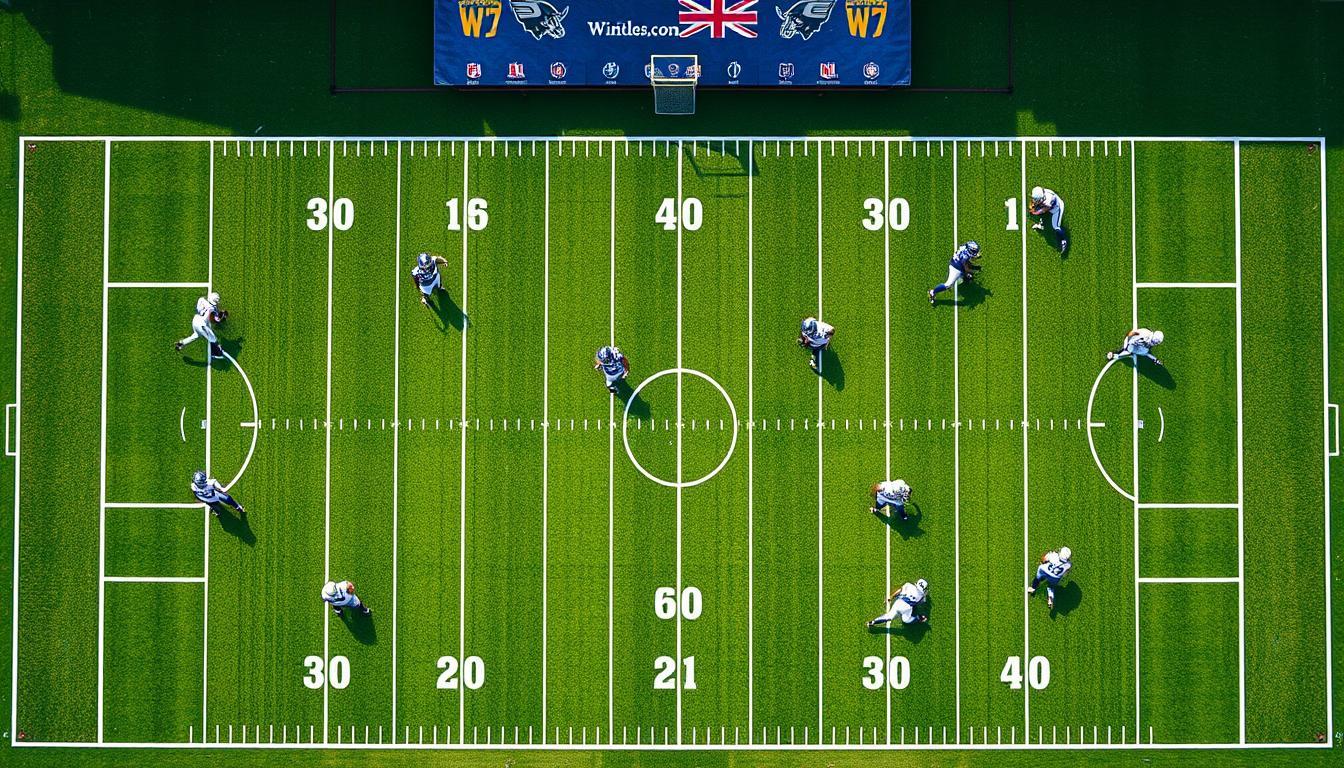
Formations are how players are arranged before the play starts. Understanding this helps you recognize player roles in action. On offense, the most popular is the “I-formation”—a straight line behind the quarterback with two running backs. On defense, the “4-3 formation” uses four linemen and three linebackers, giving flexibility against various offensive plays.
According to Statista, the 4-3 defense accounts for over 40 percent of base defenses used in Division I college football (Source: Statista, 2023). The prevalence of these formations explains why knowing positions like linebacker and defensive end is crucial—they’re in play almost every down.
# How to Identify Football Offense and Defense Positions in Real Time: 5-Step Process
Ever wanted to spot every role as a play unfolds? Here’s a quick method that even our scouting team uses when watching games live:
1. Observe the quarterback: Find the player behind the center—offense always starts here.
2. Map the offensive line: Look for the group forming a wall—left tackle, guards, and center.
3. Spot the wide receivers and tight ends: They line up on the far sides or next to the line.
4. Focus on the defensive linemen: Closest to the ball, trying to break through.
5. Check the backfield: Linebackers stand a few yards off the line (defense), running backs are behind the QB (offense). Safeties and corners are furthest back.
To make this foolproof, practice with recorded games, pausing and labeling each position. Soon, you’ll do it naturally.
# Real-World Example: How Position Mastery Wins Games
Let’s use the 2020 NFL Super Bowl as a prime example. The Kansas City Chiefs used their quarterback’s mobility and the versatility of their tight end to attack mismatches in the San Francisco 49ers’ defensive lineup (Source: NFL.com, 2020 Super Bowl Analysis). Their offense adapted formations to stretch the 49ers’ linebackers and secondary, catching them off guard and leading to a late-game comeback victory.
The lesson? Knowing and exploiting football offense and defense positions can be the difference between winning and losing, both for teams and for fans making predictions.
# WARNING: Common Mistakes with Football Offense and Defense Positions
Many fans confuse similar-sounding positions or believe that one athlete can easily switch roles mid-game. However, NFL player data shows that only 8 percent of current starters have played multiple core positions professionally (Source: ESPN Player Research, 2023). Physical requirements and specialized skill sets make switching very rare. Another common mistake is underestimating the importance of offensive linemen—without them, even the most talented quarterback stands no chance.
# Expert Tips: Optimizing Player Selection and Training
From our experience managing a youth football camp, we’ve seen that aligning a player’s natural abilities with the right position is key for their growth. For example, a fast but slight athlete may excel as a wide receiver rather than a linebacker. Drilling fundamental skills—like tackling form and route running—early pays off in the long run.
Here are some expert strategies:
– Analyze player speed and agility using timed drills.
– Test hand-eye coordination with passing and catching exercises.
– Assign practice reps to both offensive and defensive roles to identify natural fits.
– Use video breakdowns to teach position responsibilities.
– Encourage players to study standout professionals in each role.
# Football Offense and Defense Positions Checklist
Ready to put this knowledge to work? Here’s your practical football positions checklist:
– Review basic roles for all offense and defense positions.
– Practice identifying each role on live broadcasts or recordings.
– Test your understanding with friends or teammates—quiz each other on formations.
– Monitor top players and their position-specific stats.
– Continually update your knowledge as new formations and hybrid roles emerge.
# Conclusion: Become a Football Position Pro
Mastering football offense and defense positions gives you power—whether you’re playing, coaching, or just want smarter conversations on game day. Now you know what each position does, how to spot them, and why every role matters. With this foundation, you’ll read the field like an expert and enjoy the game on a whole new level.