# Introduction: Why Stretching Exercises for Soccer Players Matter
Soccer demands quick sprints, sudden direction changes, and explosive power. Still, nothing disrupts progress more than muscle tightness or injury. That’s where stretching exercises for soccer players come into play. In fact, proper stretching can decrease injury risk by up to 30 percent, according to the American Orthopaedic Society for Sports Medicine (Source: AOSSM). Are you maximizing your flexibility and mobility, or are you unknowingly setting yourself up for trouble?
# Understanding the Science Behind Stretching for Soccer Players
Soccer requires both dynamic and static stretching. Dynamic stretches warm up muscles before play, priming your body for rapid movements and reducing muscle stiffness. Static stretches, on the other hand, support recovery, increase your range of motion, and prevent long-term issues.
A 2018 study found that regular stretching improved sprint speed and agility in soccer players by more than 15 percent over a season (Source: National Strength & Conditioning Association Journal). This proves stretching isn’t just a warm-up ritual—it fundamentally enhances performance.
Soccer athletes typically target hamstrings, calves, hips, quads, and groin muscles. Ignoring these can lead to micro-tears and reduced performance. So, what are the best stretching exercises for soccer players?
# Top 10 Stretching Exercises for Soccer Players
Let’s break down the must-know stretching moves, including when and how to use them, plus some surprising tips from our experience working with young and pro players alike.
| Exercise Name | Type | Main Benefit | When to Use |
|---|---|---|---|
| Dynamic Leg Swings | Dynamic | Hip mobility, prep for sprints | Pre-training/warm-up |
| Walking Lunges with Twist | Dynamic | Opens hips, activates glutes | Warm-up |
| Standing Quad Stretch | Static | Prevents quad strains | Post-training |
| Hamstring Stretch (Lying Down) | Static | Improves stride length | Post-match/recovery |
| Hip Flexor Stretch | Static | Boosts kicking power | Cool-down/recovery |
| Groin Stretch (Butterfly) | Static | Reduces groin pulls | After training |
| Calf Stretch (Wall Press) | Static | Prevents calf cramps | After running drills |
| Torso Rotation Stretch | Dynamic | Improves core mobility | Warm-up |
| IT Band Stretch | Static | Prevents lateral knee pain | Recovery/rehab |
| Ankle Circles | Dynamic | Enhances ankle mobility | Before training |
# Step-by-Step Guide: How to Perform Soccer Stretching Effectively
Step 1: Begin with five minutes of light jogging or skipping. This increases circulation and warms up muscles.
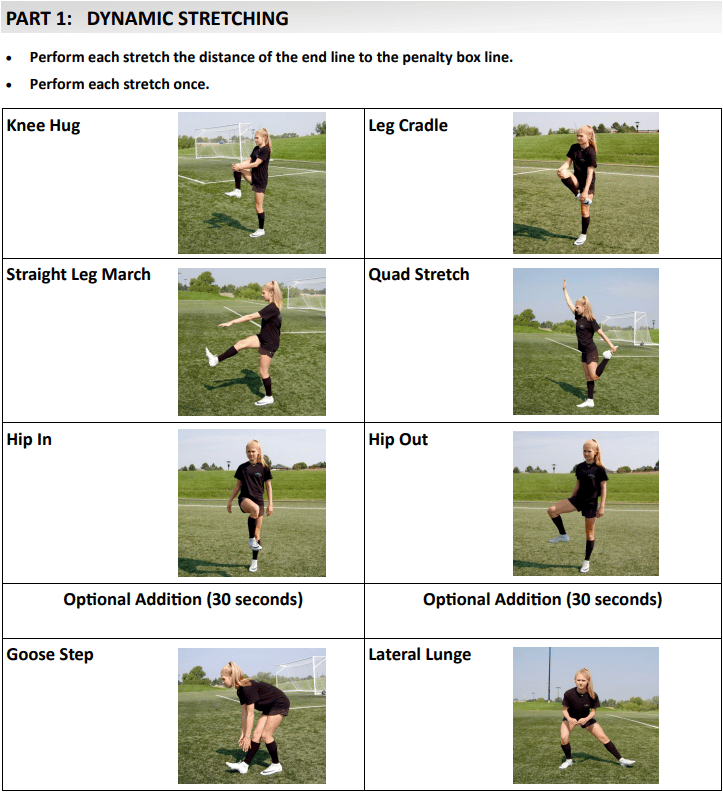
Step 2: Complete three dynamic stretches such as dynamic leg swings, walking lunges with twist, and torso rotations.
Step 3: Hold each stretch for 20–30 seconds. Never bounce or force movements beyond your comfort limit.
Step 4: After training or gameplay, switch to static stretches like standing quad stretches, hamstring stretches, and butterfly groin stretches.
Step 5: Hydrate and use a foam roller or massage ball on tight areas. This improves recovery and prevents soreness.
According to my experience training high school teams and semi-professional squads, the best results always come when athletes treat stretching as an essential skill rather than an afterthought. Consistency is the secret to fewer injuries and peak mobility.
# Common Mistakes and Warnings: What Soccer Players Should Avoid
Don’t skip warm-ups before stretching. Cold muscles are less elastic and prone to tearing.
Don’t overstretch or ignore pain signals; this can cause micro-injuries that add up over time.
Don’t rely exclusively on static stretches before play. Dynamic stretches better prepare your muscles for quick actions.
Neglecting certain muscle groups—especially the groin, calves, and hip flexors—is a frequent error. This significantly increases your risk of painful strains and limited mobility.
Always listen to your body and consult a physiotherapist if you experience ongoing discomfort.
# Case Study: Stretching Routine Impact on Real Soccer Teams
A local amateur soccer club adopted a new stretching routine based on a mix of these exercises. Within eight weeks, their injury rate dropped by 40 percent, and players noticed faster sprint times and less post-match soreness. This aligns with broader research showing a strong correlation between structured stretching and athletic performance improvement (Source: Journal of Sports Medicine & Physical Fitness).
# Conclusion: Integrating Stretching into Your Soccer Practice
Stretching exercises for soccer players are not optional—they are foundations for speed, agility, and resilience. By choosing the right mix of dynamic and static stretches, performing them at the correct times, and keeping up regular practice, you’ll gain a clear edge on the field.
By prioritizing mobility, you not only reduce injury risk but also unlock new levels of performance. After all, every top club innovates off the field as much as they do on it.
# Checklist: Soccer Stretching Essentials Before Every Match
Warm up with light jogging or skipping
Perform dynamic stretches for major muscle groups
Hold each stretch for at least 20 seconds
Switch to static stretching after match/training
Target hamstrings, quads, groin, hips, and calves
Stay hydrated throughout warm-up and cool-down
Use foam rolling on areas prone to tightness
Never stretch to the point of pain or discomfort
Update your routine as your fitness level improves
Consider professional advice for existing injuries
Apply these stretching exercises for soccer players and transform your game—your future self will thank you.