Football is more than just a game of scoring goals. It’s a complex tactical sport where each player has a unique role on the field. But what are the different positions in football, and how do they impact the outcome of every match? If you’ve ever wondered about this, you’re in the right place. In this expert guide, I’ll break down every position, their duties, skills required, and insider tips that only seasoned fans—and players—usually know.
# Understanding What Are the Different Positions in Football
Before diving deep, let me clarify that this article is about association football, which you may also know as soccer. The question “what are the different positions in football” points to those defined player roles making up a team’s tactical blueprint. While names can vary slightly by region or formation, the fundamentals remain the same globally.
# Main Categories of Football Positions
Let’s start by classifying positions into four main categories. When you search for what are the different positions in football, you’ll often find references to Defenders, Midfielders, Forwards, and Goalkeepers. Each brings something crucial to the pitch.
| Category | Main Roles | Key Skills | Example |
|---|---|---|---|
| Goalkeeper | Shot-stopping, organizing defense | Reflexes, communication | Alisson Becker |
| Defenders | Tackling, marking, blocking | Strength, positioning | Virgil van Dijk |
| Midfielders | Passing, creating chances | Vision, stamina | Kevin De Bruyne |
| Forwards | Scoring goals, pressing | Finishing, speed | Erling Haaland |
# Detailed Breakdown of Each Football Position
To answer what are the different positions in football more precisely, let’s get granular.
GOALKEEPER
The backbone of any team. Their responsibilities include saving shots, claiming crosses, and organizing defenders. Stats show goalkeepers make, on average, 3-5 saves per game in major leagues (Source: FBref.com).
DEFENDERS
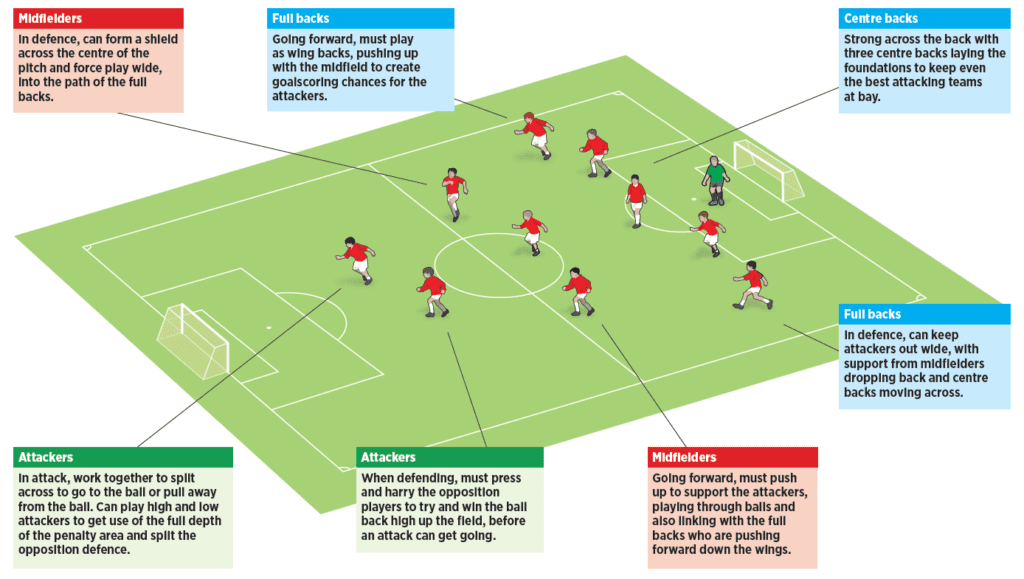
Center-Back: The main stoppers, usually tall and strong.
Full-Back: Positioned wide, often tasked with tackling wingers and overlapping in attack.
Wing-Back: Like full-backs but with even more attacking freedom in formations like 3-5-2.
MIDFIELDERS
Defensive Midfielder: Screens the defense, breaks up play.
Central Midfielder: The heartbeat—connecting defense and attack, dictating tempo.
Attacking Midfielder: Operates closer to forwards, key for chance creation.
Wide Midfielder/Winger: Stretches play, delivers crosses, tracks back in defense.
FORWARDS
Striker: The main scorer, always seeking space and shooting opportunities.
Second Striker/Support Forward: Drops deeper, links play, often creative.
Winger (Advanced Forward): Hugs the touchline; their main asset is pace.
# How Team Formations Transform Football Positions
Formations redefine what are the different positions in football by shifting player responsibilities. For example, a 4-3-3 looks like this:
– 4 Defenders: 2 Center-Backs, 2 Full-Backs
– 3 Midfielders: 1 Defensive, 2 Central/Attacking
– 3 Forwards: 2 Wingers, 1 Striker
Contrast that with a 3-5-2, where wing-backs must defend and attack relentlessly. Interestingly, tactical shifts like these exploded in the past decade. According to Opta, over 70 percent of top European teams experimented with three-at-the-back systems during the 2021/22 season (Source: Opta Analyst).
# How to Recognize Each Position on the Pitch: Step-by-Step Guide
Curious about how to tell what are the different positions in football just by watching? Follow this 5-step checklist:
STEP 1: Observe starting positions during kickoff; defenders remain deepest, forwards closest to the opponent’s goal.
STEP 2: Watch how players move when the ball is lost; midfielders often drop back to support defense.
STEP 3: Notice which players hug the sidelines—that’s usually your wingers or full-backs.
STEP 4: Identify who handles the ball the most in transition; central midfielders orchestrate play.
STEP 5: Look for the player wearing gloves and a different jersey—your goalkeeper.
# Common Misconceptions and Mistakes
WARNING
Many new fans assume all forwards are the same or that midfielders only pass sideways. In reality, each role within a category—like holding midfielder versus creative midfielder—demands different skills and tactical discipline. Ignoring these subtleties can lead to misunderstanding basic team strategies or even underappreciating player performances.
# The Real Impact of Specialized Football Positions
As someone who’s worked alongside coaching staff, I’ve seen firsthand how a single change—like shifting a full-back to a wing-back—can revolutionize a team’s attacking threat. Each position’s complexity means coaches spend hours crafting specific drills for every player, not just generic exercises.
Remember, the best teams aren’t just packed with talent but with specialists in every role. Evaluating what are the different positions in football isn’t just trivia—it’s the secret to decoding real match tactics and appreciating the beautiful game at a whole new level.
# Your Ultimate Football Positions Checklist
– LEARN category names: Goalkeeper, Defender, Midfielder, Forward
– IDENTIFY main sub-roles (center-back, winger, striker, etc.)
– WATCH different team formations and how roles shift
– DISTINGUISH between defensive and attacking responsibilities
– TRAIN eyes to pick out key position behaviors (like overlapping runs)
– AVOID lumping similar-looking roles together—details matter
– REVIEW pro matches and see how elite players interpret roles
– CHECK match reports for player position listings
– NEVER stop exploring tactical innovations—position names can evolve!
With this guide, you now have a complete answer to what are the different positions in football—plus the tools to recognize, analyze, and enjoy every role on the field like an expert.