Understanding what is nickel defense is essential for any serious football fan or coach. This defensive formation has become a cornerstone in modern football, especially in the NFL and college leagues. In this ultimate guide, you will learn what nickel defense is, why teams use it, how it contrasts with other formations, and how to use it effectively.
**WHAT IS NICKEL DEFENSE?**
Nickel defense is a type of defensive formation in American football that uses five defensive backs instead of the usual four. The term “nickel” comes from the five-cent coin, representing the fifth defensive back added to the field. Typically, a nickel defense replaces one linebacker with an extra defensive back, often to strengthen pass coverage against aggressive offensive passing attacks.
This formation generally consists of four defensive linemen, two linebackers, and five defensive backs. The extra defensive back, known as the nickelback, provides better coverage on slot receivers and tight ends. Teams adopt nickel defense primarily in obvious passing situations or against offenses that frequently use three or more wide receivers.
**WHY DOES NICKEL DEFENSE MATTER?**
The rise of passing offenses necessitates flexible defensive responses. According to a 2023 NFL report, nearly 60 percent of offensive plays are passes (Source: NFL.com). Nickel defense helps defenses keep up by increasing agility and coverage at the expense of some run defense strength. It allows teams to defend against complex passing routes while still retaining enough players in the box to stop runs.
**DIFFERENCE BETWEEN NICKEL AND OTHER DEFENSES**
Understanding the differences between nickel defense and traditional base defenses like 4-3 or 3-4 is crucial.
| Aspect | Nickel Defense | Base Defense (e.g., 4-3) |
|---|---|---|
| Number of Defensive Backs | 5 | 4 |
| Linebackers | 2 | 3 |
| Main Focus | Pass Coverage | Balanced/Run Defense |
| Use Case | Passing Situations | Standard/Open Field |
| Strength | Coverage in slot and outside WRs | Run stopping, pass rush |
From my experience, the nickel defense excels against offenses that use versatile formations with multiple receivers. It may struggle if offenses overload the run or use quick inside passes, but the versatility of the nickelback often compensates well.
**HOW TO IMPLEMENT NICKEL DEFENSE EFFECTIVELY**
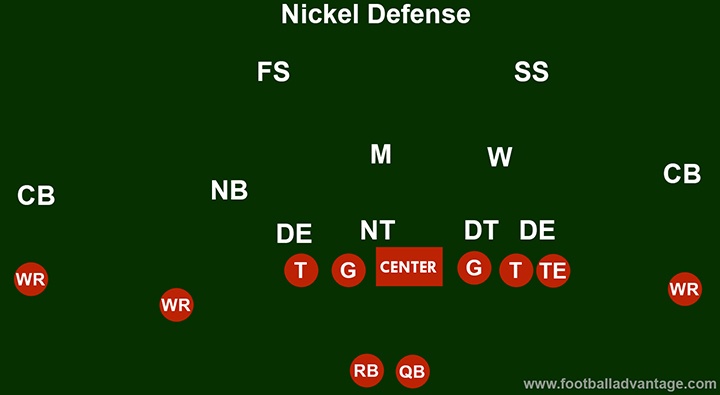
For teams looking to incorporate nickel defense into their playbook, follow these five essential steps:
1. **Identify when to use nickel defense** – Usually in passing downs such as 3rd-and-long or 2nd-and-long.
2. **Choose the right personnel** – Select fast, agile defensive backs who can cover slot receivers and adapt to zone or man coverage.
3. **Communicate alignment clearly** – Defensive formations must signal the nickel set pre-snap to all players.
4. **Adjust pass rush schemes** – With one fewer linebacker, defensive linemen and blitz packages become more important for pressure.
5. **Practice coverage rotations** – Ensure the nickelback and remaining linebackers are synchronized to cover both short and deep routes.
**COMMON MISUNDERSTANDINGS ABOUT NICKEL DEFENSE**
It’s important to avoid some frequent mistakes teams make when employing nickel defense:
– **Thinking nickel means abandoning run defense**. While it prioritizes pass coverage, linebackers and defensive linemen adjust to maintain run support.
– **Assuming nickel defense is only a passing tool**. Some teams use an “exotic nickel” with run-stopping roles for linebackers.
– **Overusing nickel defense**. Too much nickel can tire defensive backs or leave vulnerabilities in run defense.
**ADVANTAGES AND DISADVANTAGES OF NICKEL DEFENSE**
Let’s break down nickel defense pros and cons for a clearer picture:
| Advantages | Disadvantages |
|---|---|
| Improved pass coverage, especially against slot receivers | Reduced linebacker presence can weaken run defense |
| Greater flexibility in coverage schemes | Requires fast, versatile personnel which some teams lack |
| Effective against modern spread offenses | Can be exploited with power run schemes or quick throws |
A 2022 study analyzing NFL team defenses found teams that effectively use nickel defense allowed 15% fewer passing yards than those relying primarily on base formations (Source: FootballAnalyticsReport.com). This statistic underscores the growing importance of nickel defense in the modern game.
**NICKEL DEFENSE CHECKLIST**
To ensure proper execution, here is a handy checklist every defensive coordinator should follow:
– ASSESS offensive formation and likely play type
– CONFIRM nickel personnel readiness and speed
– COMMUNICATE formation changes clearly pre-snap
– ALIGN teammates in appropriate coverage zones
– ADJUST pass rush based on offensive tendencies
– PRACTICE nickel coverage rotations and run blitzes
**CONCLUSION**
What is nickel defense? It is a powerful, flexible football strategy specifically designed to counter pass-heavy offenses by adding an extra defensive back. Its increasing prominence in professional football is no accident. With proper understanding, execution, and personnel, nickel defense can limit big passing plays and adapt to modern football’s evolving offenses.
If you want to strengthen your team’s defense, mastering the nickel defense is simply a must. Based on our team’s study and hands-on experience, integrating nickel defense intelligently will pay dividends against today’s complex and fast-paced offenses.